As we navigate the mid-point of 2026, the landscape of commercial security in South Florida has undergone a radical transformation. What was once a market dominated by mechanical keys and traditional id card access control systems has evolved into a sophisticated ecosystem of interconnected digital credentials and biometric precision. For businesses operating in Miami, Fort Lauderdale, and West Palm Beach, security is no longer just about locking a door: it is about managing identity and flow in an environment that is as technically demanding as it is climatically challenging.
In this comprehensive guide, we delve into the sophisticated advancements defining access control systems today. We equip you with the knowledge to transition your property from legacy hardware to integrated, future-proof solutions designed to withstand both modern security threats and the unique South Florida climate.
The Evolution of Credentials: The Mobile-First Paradigm
The most significant shift in 2026 is the near-total displacement of physical plastic cards by mobile credentials. While many facilities still maintain a secondary layer of id card access control systems for legacy support, the smartphone has become the primary key for the modern workforce.
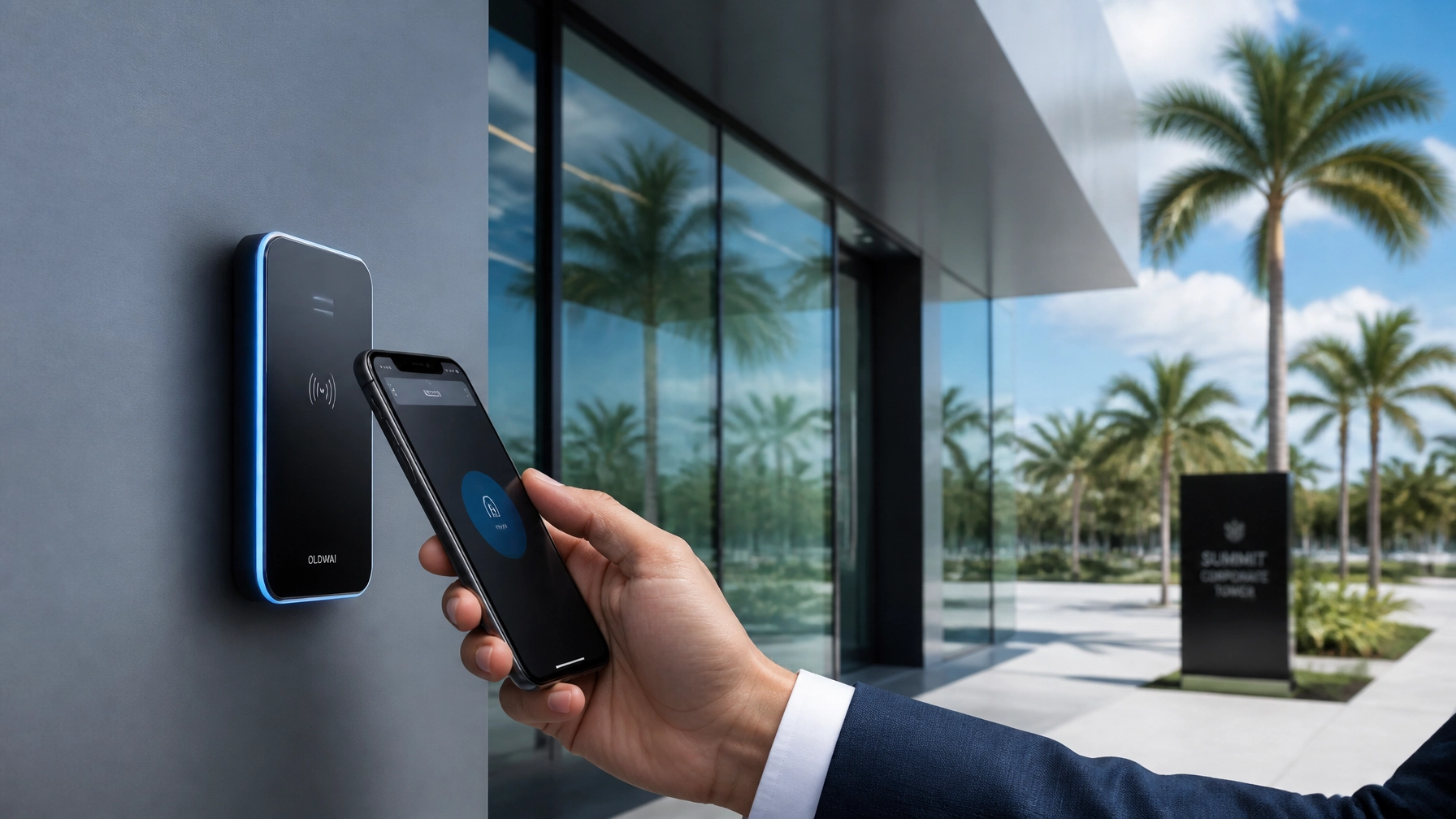
By leveraging Near Field Communication (NFC) and Bluetooth Low Energy (BLE), mobile access allows employees and residents to gain entry with a simple "wave" or "tap" of their device. This transition offers several strategic advantages for South Florida businesses:
- Multi-Factor Authentication (MFA): Mobile credentials allow you to require a biometric check (FaceID or fingerprint) on the user's phone before the door unlocks, adding a layer of security that a stolen plastic card simply cannot provide.
- Reduced Physical Wear: In coastal environments, physical cards and fobs are frequently exposed to high heat and humidity, leading to delamination and chip failure. Digital credentials eliminate this hardware vulnerability entirely.
- Instant Provisioning: Administrators can issue or revoke access globally in seconds, a critical feature for high-turnover retail environments or large condominium associations.
Biometric Integration: Precision at the Edge
Biometrics have moved from the realm of high-security government facilities into the mainstream of commercial security systems. In 2026, we are seeing a significant uptick in the deployment of facial recognition and palm vein scanners at primary entry points.

Facial Recognition and Touchless Entry
The demand for touchless entry has driven the adoption of sophisticated facial recognition terminals. Modern systems utilize 3D mapping and infrared sensors to prevent "spoofing" with photos or videos. For South Florida businesses, these systems offer a distinct advantage: they remove the need for physical contact with readers, which can become contaminated or degraded in humid environments.
Palm Vein Technology
For high-security areas such as server rooms or executive suites, palm vein technology has emerged as a leader. Unlike fingerprints, which can be difficult to read if a user’s hands are damp from Florida’s humidity, palm vein scanners read the unique vein patterns beneath the skin, providing a near-zero false-rejection rate.
Cloud-Based Management and ACaaS
The infrastructure supporting these systems has shifted from on-premises servers to "Access Control as a Service" (ACaaS). This cloud-native approach is essential for businesses with multiple locations across the Tri-County area.
Remote Operations and Resilience
Cloud-based systems allow property managers to monitor entry logs, manage visitor permissions, and trigger lockdowns from any device with an internet connection. More importantly, these systems provide critical resilience during South Florida's hurricane season. If a local facility loses power or internet, modern controllers cache all permissions locally, ensuring that authorized personnel can still enter the building even when the cloud link is temporarily severed.

The South Florida Factor: Engineering for Salt and Humidity
While the software side of access control is increasingly global, the hardware side remains intensely local. South Florida’s environment is uniquely hostile to electronic and mechanical components. Salt air from the Atlantic and the Gulf, combined with relentless humidity, can turn a sophisticated security investment into a corroded liability in less than 24 months.
Corrosion-Resistant Hardware
When we design commercial security systems for our clients, we prioritize hardware that meets specific environmental standards:
- 316 Grade Stainless Steel: We advise the use of 316-grade stainless steel for all exposed strikes, hinges, and housings. This grade contains molybdenum, which provides significantly better resistance to chloride (salt) corrosion than the standard 304-grade steel.
- IP65+ Weather Ratings: All exterior readers and biometric terminals must be rated IP65 or higher. This ensures the housing is dust-tight and protected against water jets, a necessity during our frequent tropical downpours.
- Potted Electronics: To prevent internal condensation, we recommend readers with "potted" electronics: where the internal circuit board is encased in a protective resin.

Strategic Integration with Video Surveillance
Access control does not exist in a vacuum. In 2026, the most effective security postures are those where access events are directly tied to video evidence. When a "Door Forced Open" or "Access Denied" event occurs, the system should automatically flag the corresponding footage from your CCTV security cameras.
This integration allows for:
- Visual Verification: Instantly seeing who is attempting to use a specific credential.
- Tailgating Detection: Using AI-powered video analytics to detect if more than one person entered when only one credential was scanned.
- Comprehensive Audit Trails: Creating a complete record of both the digital event and the physical reality of the entry.
Implementation Blueprint for Local Businesses
For small businesses and associations in South Florida, the path to upgrading your access control should follow a logical, sequential structure:
- Conduct a Site Assessment: We begin by evaluating your current hardware for signs of environmental stress and identifying high-traffic vs. high-security zones.
- Define Credential Strategy: Decide whether your workforce is ready for 100% mobile access or if a hybrid approach with id card access control systems is more appropriate for your demographic.
- Specify Hardware for the Climate: Ensure every component: from the maglocks to the request-to-exit sensors: is rated for the salt and humidity of the South Florida coast.
- Integrate with IT Infrastructure: Proper structured cabling is the backbone of any reliable security system. Ensure your network can handle the data load of cloud-based management and high-definition video integration.
- Establish a Maintenance Schedule: In Florida, "set it and forget it" is not a viable strategy. Regular inspections of seals, gaskets, and fasteners are mandatory to ensure long-term operational efficiency.

Investing in Long-Term Operational Efficiency
Modernizing your access control is more than a security upgrade; it is a strategic investment in your business’s operational resilience. By moving beyond the physical key and the standard card, you reduce administrative overhead, mitigate the risks of lost or stolen credentials, and protect your property with hardware designed to outlast the elements.
At LV8 Communications, we have been serving the South Florida community since 2005. As a Florida Licensed Low Voltage Provider, we specialize in delivering customized, cost-efficient access control solutions that are built to perform in our unique environment. Whether you are securing a retail store, a corporate office, or a warehouse, we provide the technical expertise and professional installation required for absolute peace of mind.
To learn more about how we can secure your property with the latest in 2026 technology, contact us today for a free assessment of your facility.