As we navigate the mid-point of 2026, the landscape of commercial security has undergone a fundamental transformation. For South Florida businesses, the reliance on passive recording devices has been rendered obsolete by the arrival of autonomous, intelligent monitoring. In a region defined by rapid urban growth, high-value commercial assets, and a volatile subtropical climate, security is no longer merely about documenting incidents after they occur; it is about proactive prevention and environmental resilience.
The integration of Artificial Intelligence into security camera systems has transitioned from a premium novelty to a baseline operational requirement. We delve into the technological advancements that have established AI-powered surveillance as the 2026 standard, and we equip you with the strategic knowledge necessary to protect your enterprise in the unique South Florida environment.
The Intelligence Shift: From Motion Detection to Intent Analysis
Traditional surveillance systems relied on simple motion sensors, which frequently resulted in a deluge of false positives caused by shifting shadows, wind-blown foliage, or heavy Florida rain. In 2026, the industry has pivoted to "Edge AI": a paradigm where processing occurs directly on the camera hardware rather than in a distant cloud server.
Object Detection and Human/Vehicle Filtering
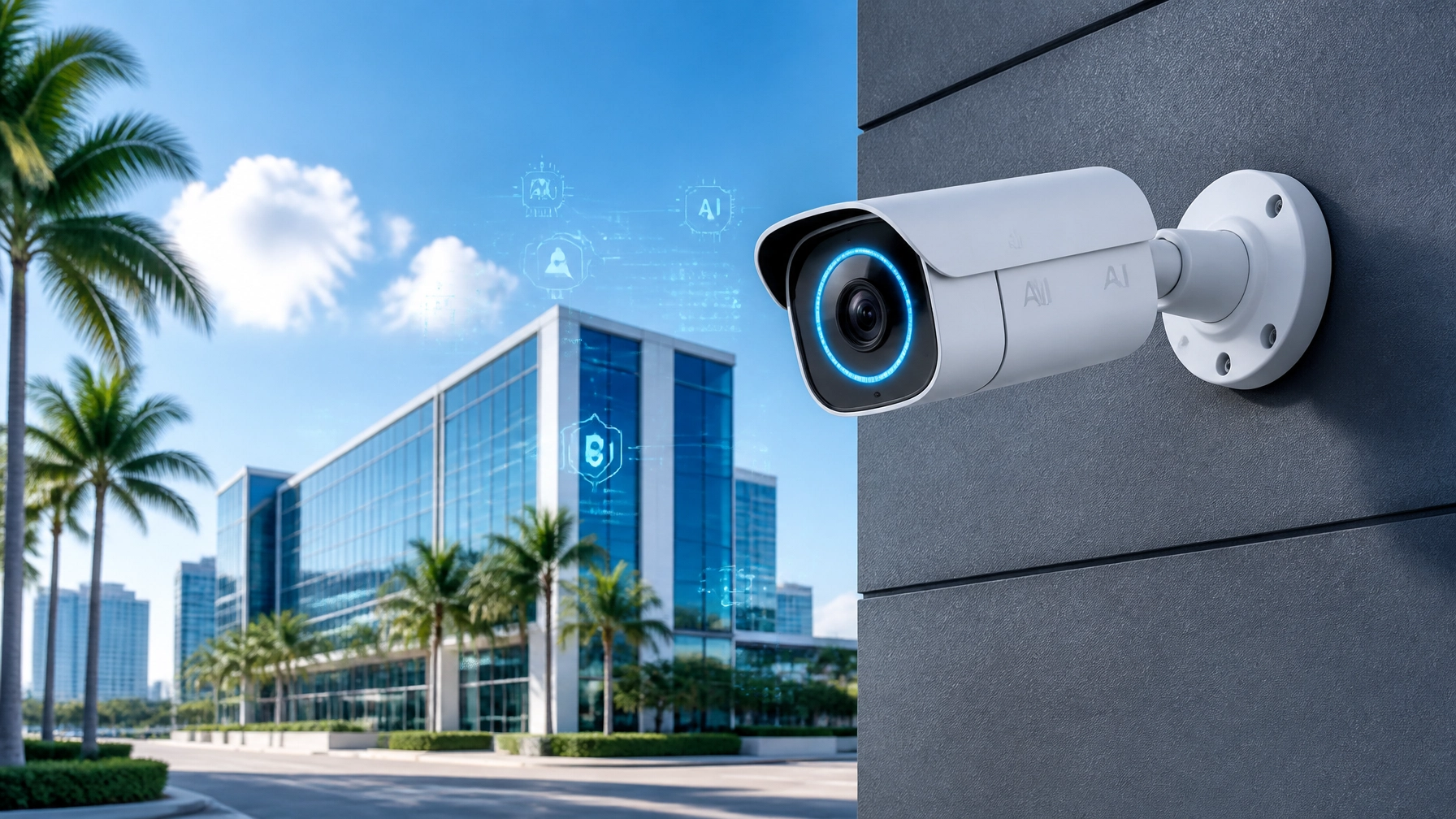
Modern business security cameras now utilize sophisticated Neural Processing Units (NPUs) to distinguish between benign movement and genuine threats. These systems can identify and categorize objects: such as delivery vans, pedestrians, or unauthorized vehicles: with over 95% accuracy. This precision allows facility managers to filter alerts, ensuring that security personnel are only notified when a specific, pre-defined condition is met.
Anomaly and Behavioral Detection
Beyond simple identification, 2026-standard cameras employ behavioral analytics to detect intent. We are seeing a widespread implementation of loitering detection, where the AI recognizes if an individual has remained in a sensitive zone for an unusual duration. Furthermore, anomaly detection algorithms can identify "out-of-character" events, such as a vehicle approaching a loading dock at 3:00 AM or a person moving against the established flow of traffic in a retail environment.

Engineering for the South Florida Climate
While software intelligence is paramount, the hardware must be engineered to withstand the brutal environmental demands of South Florida. Heat, humidity, salt air, and hurricane-force winds are not just variables; they are constants that can degrade an inferior system within months.
Thermal Resilience and IP Ratings
The intense UV exposure and humidity in cities like Miami and Fort Lauderdale require hardware with high-grade ingress protection. We recommend systems with a minimum rating of IP67, which ensures the internal AI components remain sealed against moisture and airborne salt. Additionally, 2026 models often feature advanced heat dissipation designs to prevent the NPU from throttling during peak summer temperatures.
Hurricane Season and Physical Stability
In South Florida, the structural integrity of your cctv-installations is tested annually by the Atlantic hurricane season. Choosing the right provider is crucial; professional installation must include corrosion-resistant mounts and fasteners capable of withstanding high wind loads. Furthermore, the 2026 standard involves structured cabling that is properly shielded and grounded to protect the system's delicate electronics from the electrical surges that frequently accompany tropical storms.
Strategic Integration: The Convergence of Security and IT
In 2026, commercial security systems do not exist in a vacuum. They are a critical component of a business’s broader IT infrastructure. Strategic investment in surveillance now involves a holistic approach that integrates video with other building systems.
Hybrid Cloud Architectures
For South Florida businesses, a hybrid cloud model has become the gold standard for data redundancy. In this setup, critical footage is stored both locally and in a secure cloud environment. If a local site loses power or suffers physical damage during a storm, the video data remains accessible remotely, ensuring continuity of evidence and operational oversight.
Video Surveillance and Access Control
The synergy between video surveillance for office environments and access control systems has created a "Zero Trust" physical environment. In 2026, cameras act as a visual verification layer; when an employee or visitor presents a credential, the AI camera can perform a facial or anatomical match to ensure the person holding the badge is the authorized user. This prevents credential sharing and significantly mitigates the risk of unauthorized entry.

Active Deterrence: Moving Beyond Passive Recording
The most significant evolution in 2026 is the shift toward active deterrence. Historically, cameras were tools for the police to use after a crime. Today, AI cameras are designed to stop the crime before it happens.
Many modern systems now feature integrated "Active Deterrence" components, including:
- AI-Triggered Strobes: High-intensity LED lights that activate when an intruder enters a restricted zone after hours.
- Two-Way Audio Intercoms: Allowing remote operators or automated AI voices to warn trespassers that they are under surveillance.
- Audible Alarms: Integrated sirens that can be triggered by specific AI events, such as a perimeter breach.
These features are particularly vital for South Florida warehouses and retail centers, where the presence of an active, vocal security system is often enough to divert a potential intruder to a less-protected target.
Implementation Blueprint for Business Owners
Selecting the right AI-powered system requires a calculated approach. We advise following this blueprint to ensure your investment is both effective and durable:
- Conduct a Site Assessment: Evaluate specific vulnerabilities, such as waterfront perimeters or high-traffic entry points.
- Prioritize Edge Processing: Ensure the cameras you select perform analytics locally to minimize bandwidth usage and reduce alert latency.
- Verify Licensing: Ensure your installer is a Florida Licensed Low Voltage Provider. This is a legal requirement and guarantees that the installation meets the rigorous standards needed for Florida's climate and building codes.
- Plan for Scalability: Choose an open-platform Video Management System (VMS) that allows you to add more cameras or new AI modules as your business grows.

The adoption of AI-powered security is a strategic decision that impacts long-term operational efficiency and risk mitigation. By moving toward intelligent, resilient systems, South Florida businesses can ensure they remain protected against both human and environmental threats.
As a Florida Licensed Low Voltage Provider since 2005, LV8 Communications specializes in the design, installation, and maintenance of advanced technology solutions. Whether you require a sophisticated CCTV system, structured cabling, or a comprehensive access control overhaul, our team provides the technical expertise and local experience necessary to secure your property.
For a comprehensive assessment of your business's security and technology needs, visit lv8data.com or contact our professional support team to explore a customized solution tailored to your facility.